
From the changing room to the clean workshop, eliminating human-induced cross-contamination, are your employees really “qualified in decontamination”?
Every day during shift change, have you ever witnessed such a scene:
1)Employee l only stands on the boot washing machine for 2 seconds, with the soles of his shoes still dry, and then walks over, merely “stepping on it once”;
2)When washing hands, the tap was turned on and off for less than five seconds, and the disinfectant was not used at all.
3)If a wet hand is directly wiped on the work uniform twice, the dryer becomes ineffective.
4)The ground beside the boot sink is always wet, with dirty water splashing everywhere.
These seemingly minor “slacks” are often the direct causes of excessive microorganisms, product returns, and failure to pass factory audits.
According to the AIB international unified inspection standards, the entrance for personnel is a major area where points are deducted. In the BRC 8th edition audit, the proportion of enterprises that were issued non-conformities due to “employees not operating in accordance with the prescribed decontamination procedures” exceeded 60%. Auditors will not accept an explanation like “We will strengthen management in the future” – they only look at whether the equipment and processes are designed to eliminate the possibility of human negligence. Person-to-person management is not sustainable. A truly effective solution must rely on automated processes and physical interlocks to enforce and regulate the actions of every person entering the workshop.
What do we offer you? A complete “access control level” hygiene solution for the entrance. The following process can be flexibly configured according to the cleanliness level and audit requirements of your workshop. It is suitable for workshops with high cleanliness requirements (such as ready-to-eat food, frozen baking).
Step 1: Changing outerwear and slippers
Objective: To completely isolate external contaminants before entering the clean area.
Equipment configuration: Stainless steel lockers, stainless steel shoe cabinets
Solution highlights:
- Zoned storage: Outerwear and slippers are stored separately to prevent cross-contamination.
- Stainless steel material: Corrosion-resistant, easy to clean, and meets food-grade hygiene standards.
- Ventilation design: The cabinets have air holes to reduce odors and dampness.
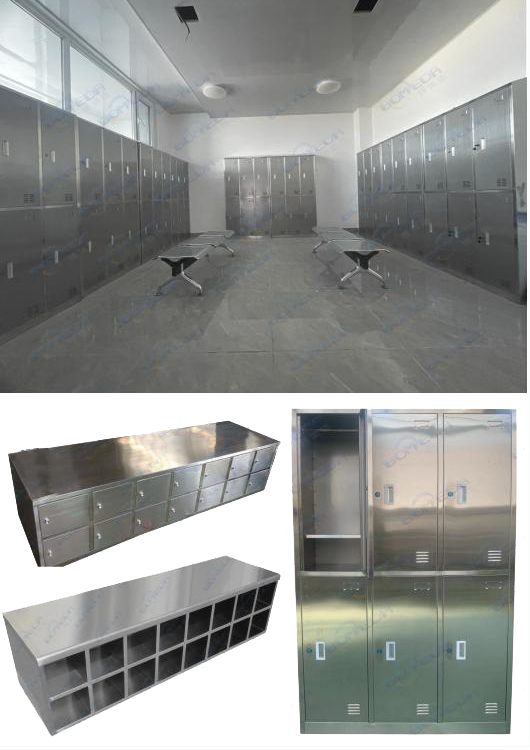
Step 2: Workwear and Clean Water Boots Dressing
Objective: Standardize the dressing process to ensure that protective equipment is clean, dry, and well-fitting.
Equipment Configuration: Coat hangers, drying water boot racks
Solution Highlights:
- Zoned management with coat hangers: Each employee has an individual hanger to prevent workwear from being crushed and deformed.
- Intelligent drying water boot racks: Capable of timed heating and dehumidification to keep the boots dry, and equipped with ozone to eliminate odors and reduce bacterial growth.
- Orderly dressing flow: Put on workwear first, then water boots, in line with hygiene operation logic.
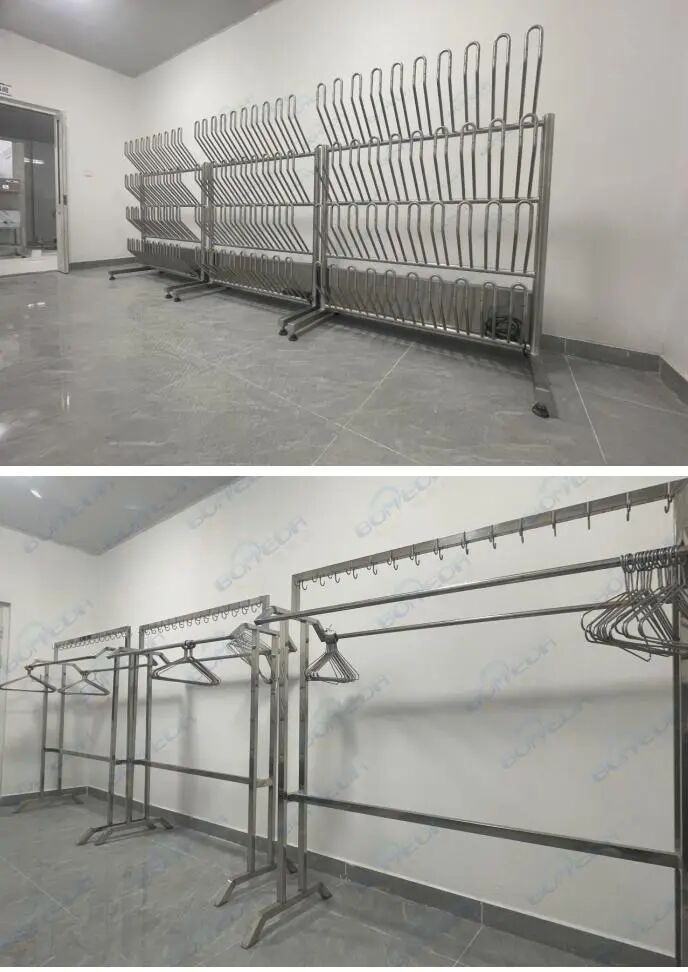
Step 3: Hand Washing
Objective: Remove surface dirt from hands to lay a foundation for subsequent disinfection.
Equipment Configuration: Fully automatic sensor hand washing sink (constant temperature water supply + automatic soap dispenser + timing display screen)
Solution Highlights:
- Zero contact throughout: Infrared sensor for water and soap dispensing to prevent secondary contamination.
- Mandatory hand washing time: Wash hands according to the standard procedure; otherwise, the sink will not operate, ensuring proper hand washing.
- Constant temperature comfort: 40±2℃ constant temperature water to enhance employee compliance.
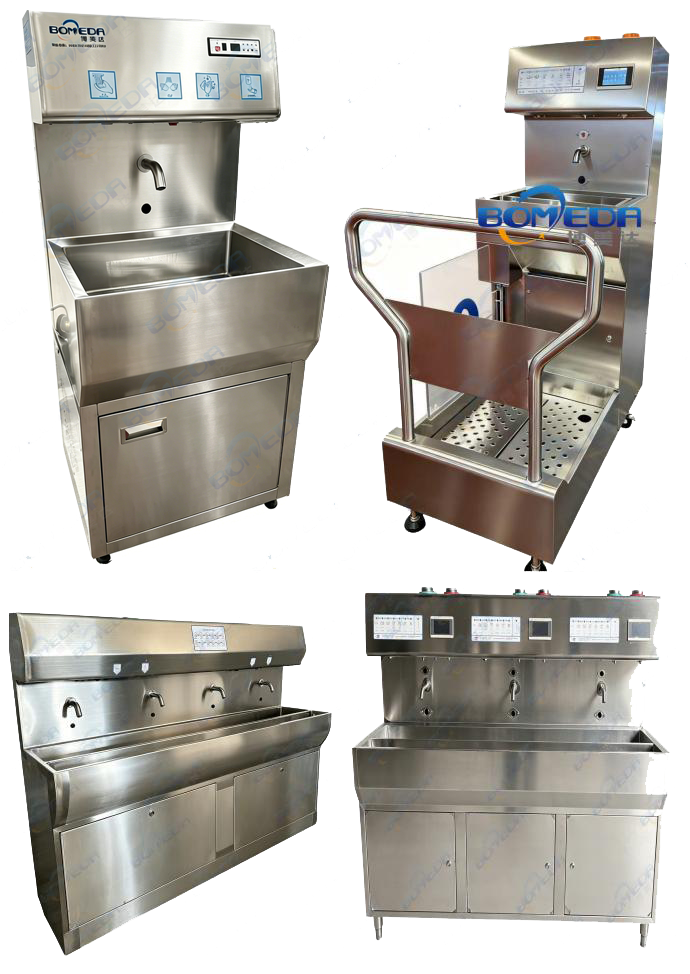
Step 4: Personnel Hygiene Cleaning Station (Integrated Boot and Hand Cleaning and Disinfection)
Objective: To achieve a one-stop deep cleaning and disinfection of water boots and simultaneous hand hygiene treatment, significantly enhancing efficiency and cleanliness.
Equipment Configuration: Channel-type personnel hygiene cleaning station (integrated with boot cleaning, boot disinfection, hand cleaning, and hand disinfection functions)
Key Features: Boot Cleaning: High-pressure spray and side brush rollers thoroughly remove bone chips, grease, and stains from the boot soles and uppers. Boot Disinfection: Optional disinfectant spray module for chemical disinfection of the outer surface of water boots. Hand Disinfection: After drying, a sensor sprays no-rinse disinfectant. Interlocking Access Control: The exit interlocking door cannot be opened until all processes are completed. Waste Water Separation: Equipped with a built-in water collection tank and filter screen to keep the floor dry and clean.
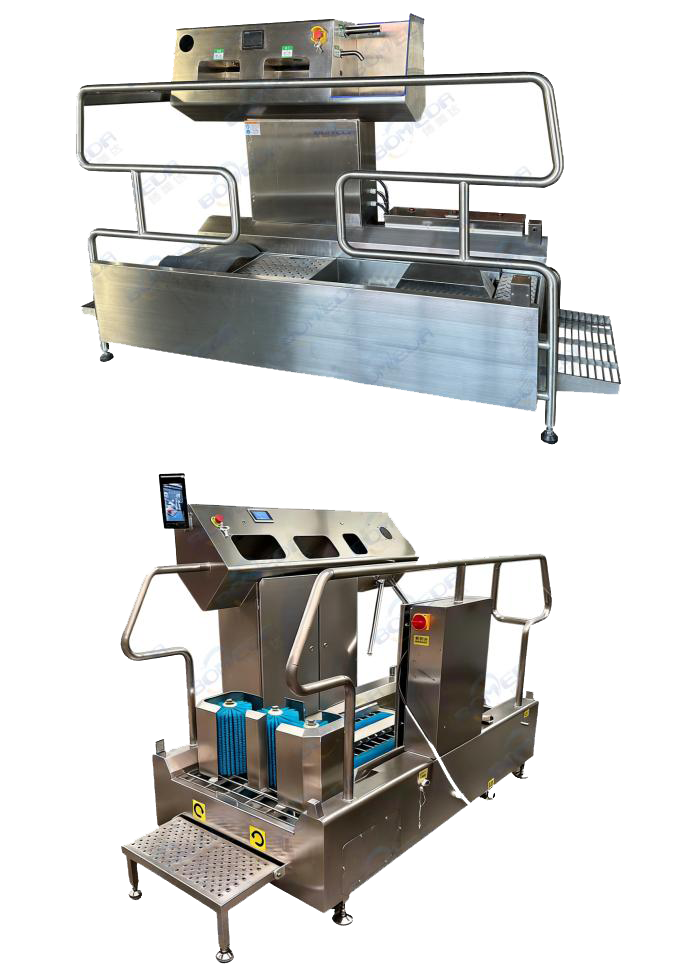
Step 5: Air Shower Dust Removal
Objective: To remove dust, hair, and dander adhering to the surface of work clothes, and to reduce particle pollution brought in by personnel.
Equipment Configuration: Stainless steel air shower room / air lock room
Key Features of the Solution: Double-door interlock: If one door is not closed properly, the other door cannot be opened to prevent channel short circuit. Automatic infrared sensor blowing shower: Activated by infrared sensor, the blowing shower time can be adjusted from 10 to 90 seconds. Adjustable nozzle angle: For employees of different heights, the blowing is carried out on the head, torso, and legs respectively. Three-sided blowing: Air is blown from the top and both sides, making the blowing more comprehensive.
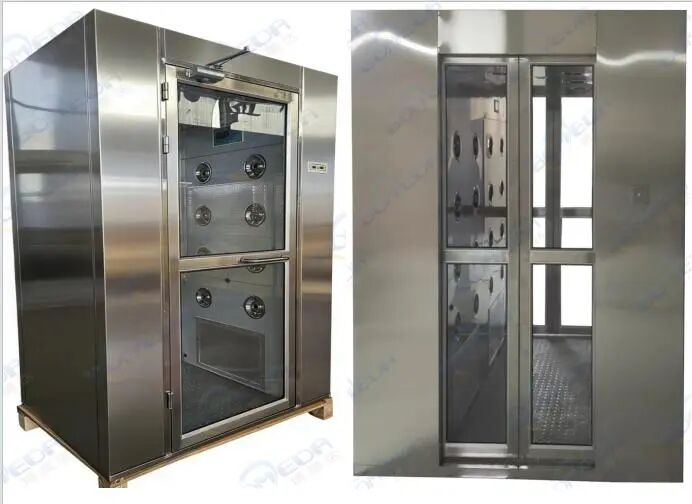
Two core technologies make “employee hygiene management” no longer dependent on constant supervision by personnel. 1. Intelligent interlock and error prevention mechanism: We have linked the signals of the boot-washing machine, hand-washing sink, air shower door, and workshop entrance door. Technically, this prevents employees from skipping steps or being lazy. Practical logic examples: l Logic A: Employees must follow the process on the boot-washing machine to open the access door l Logic B: Hand drying is not completed, hand disinfectant does not dispense l Logic C: Any wash or disinfection action is not completed, the workshop entrance door remains locked. Value: Employees cannot be lazy. You don’t need to send personnel to stand guard at the entrance every day. 2. Food-grade hygiene design – no dead corners and easy to clean: The equipment itself cannot be a source of contamination. l Full SUS304 stainless steel body, thickness ≥ 1.5mm l All weld seams are polished and polished, not prone to dirt accumulation l Pipeline can be disassembled for cleaning l The tank body adopts a large arc transition, no right-angle dead corners l No exposed screws, exposed fasteners are all made of stainless steel material Value: Compliant with GMP design standards, auditors have nothing to say when checking the hygiene dead corners of the equipment. Get your exclusive personnel passage hygiene and decontamination solution immediately. Free access: l Personnel passage layout diagram (drawn 1:1 based on your actual changing room size) l Factory inspection standard equipment parameter list l Self-check form for the personnel passage by BRC/AIB auditors You only need to provide: 1. The floor plan of your factory’s changing room (photos, hand-drawn sketches or CAD files are acceptable) 2. The auditing standards you need to pass (such as BRC/AIB/IFS) 3. The total number of people entering the workshop per shift (used to calculate the width of the passage and the number of equipment) Our commitment: After receiving the information, we will provide you with a “one factory, one policy” equipment configuration list and layout suggestions within 24 hours without charging any fees.
Post time: May-09-2026